

 会员注册
会员注册 会员登录
会员登录
报告题目
Genetic and molecular basis of maize adaptation to cold environments
个人介绍

杨淑华
中国农业大学教授
研究领域
温度胁迫是限制植物生长发育、地理分布及作物产量的重要因素之一。实验室主要从事植物低温信号感知和转导的分子机理研究:
1、以拟南芥为研究材料,系统研究植物感知与应答低温信号的分子机制,植物激素和光信号与低温信号互作的分子机制;
2、以玉米为研究材料,通过正向遗传学、反向遗传学以及多组学等技术研究挖掘玉米耐冷关键基因,并解析其分子调控机制,探索玉米高纬度低温适应性机制,创制耐低温玉米新种质。
报告摘要
Maize (Zea mays) is highly sensitive to cold stress, which severely constrains growth, phosphate (Pi) uptake, yield and geographic distribution. Here, we identified key regulators of cold tolerance, including the transcription factor COOL1. Natural variations in the COOL1 promoter alters HY5 binding and transcriptional repression, leading to reduced COOL expression. COOL1 functions as a negative regulator of cold responsive genes, whereas the protein kinase CPK17 enhances COOL1 stability under cold stress. Notably, the cold-tolerant COOL1 allele is enriched in high latitude populations, highlighting its contribution to climatic adaptation. We further identified the SPX domain-containing E3 ligase NLA as a central hub connecting cold signaling with Pi homeostasis. Under cold stress, NLA promotes the degradation of JAZ11 to activate JA signaling and enhance cold tolerance, but represses Pi uptake via InsP-dependent ubiquitination of the Pi transporter PT4. To decouple this trade-off, we engineered an NLAΔ12 allele using AI-guided structural modeling and genome editing, which disrupts InsP binding while retaining JAZ11 targeting. This redirects NLA activity toward JA signaling, improving cold tolerance,phosphorus use efficiency, and yield in multi-site field trials. Our findings reveal a regulatory network for maize cold adaptation and demonstrate how AI-assisted design can overcome stress-nutrition trade-offs to develop cold-resilient and nutrient-efficient crops.
最新研究进展
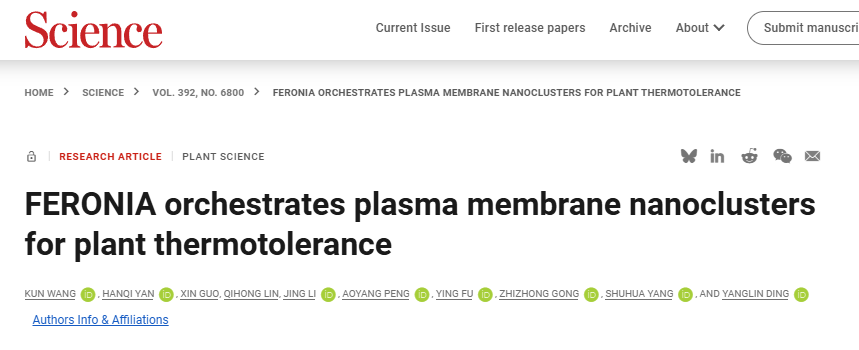
Science:发现植物高温信号感知“纳米开关”
5月22日,中国农业大学植物抗逆高效全国重点实验室、生物学院和未来技术学院丁杨林、杨淑华教授团队在《科学》(Science)发表题为《FERONIA调控质膜纳米簇介导植物耐热性》(FERONIA orchestrates plasma membrane nanoclusters for plant thermotolerance)的研究论文,揭示了定位于细胞膜的受体激酶FERONIA(FER)在高温条件下可动态组装为温度敏感的纳米簇结构,并作为热感知“开关”精准调控植物耐热性,从而阐明了植物感知与响应高温的全新分子机制。
第二十五届全国植物基因组学大会将于2026年8月19日–22日在内蒙古自治区呼和浩特市召开,大会同期将举办Plant Innovation 首届编辑委员会会议及植物遗传与基因组学专业委员会工作会议,诚邀国内同行参加!大会信息详见官网https://plantgenomics.tri-think.cn

扫码参会